How Long Does a Landlord Have to Fix AC in Florida?
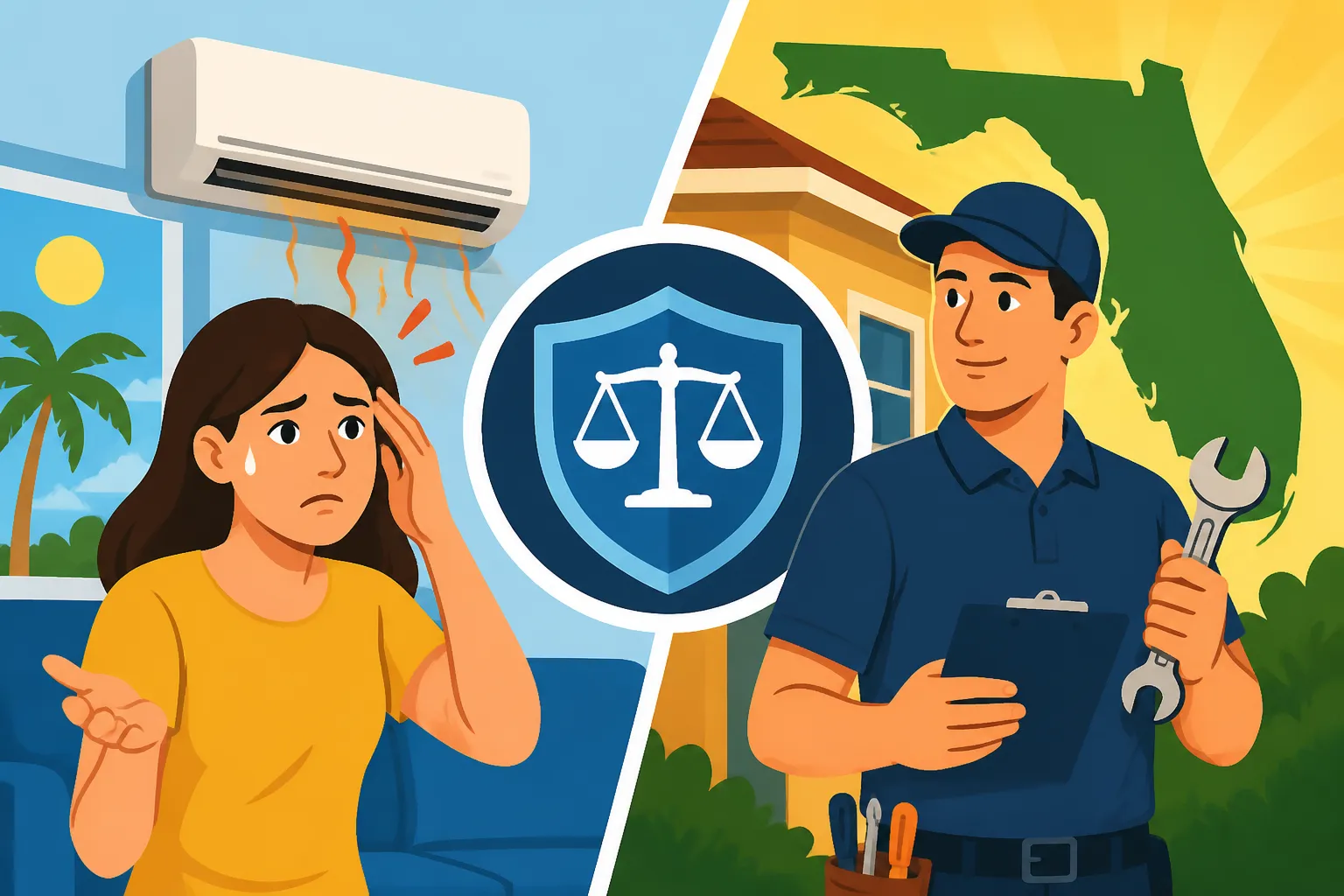
It's summer in Florida, and suddenly, your air conditioning decides to call it quits. That immediate wave of panic and frustration is completely understandable – the heat and humidity here are no joke, and a broken AC isn't just an inconvenience; it can quickly become a serious health concern. You're left wondering, "How long does my landlord have to fix this?" This guide is here to cut through the confusion and explain your rights and the landlord's obligations when it comes to AC repairs in the Sunshine State.
Navigating AC Repairs in Florida: The Core Question
When that cold air stops flowing, the first thing on every Florida renter's mind is, "When will this be fixed?" Unlike some other states where AC might be seen as a luxury, in Florida, it often feels like a basic necessity for health and safety, especially during peak summer months. However, the legal landscape for air conditioning repairs in Florida isn't as straightforward as you might hope, largely depending on what your lease agreement says and how courts interpret "essential services."
Florida's Stance on Essential Services
Florida landlord-tenant law, specifically Florida Statute § 83.51, outlines the landlord's general obligations to maintain the dwelling. This statute requires landlords to maintain "the roofs, windows, screens, floors, steps, porches, exterior walls, foundations, and all other structural components in good repair and capable of resisting normal forces and loads." It also mandates making "reasonable provisions for… functioning facilities for heat, running water, and hot water." Notice anything missing? Air conditioning isn't explicitly listed as a mandatory "essential service" that a landlord must provide or maintain unless it was explicitly agreed upon in your lease.
This is a critical distinction. If your lease agreement expressly states that the landlord provides and maintains the air conditioning system, then a broken AC falls squarely under their repair responsibilities. If, however, your lease is silent on AC, or states that AC is provided "as-is" or is the tenant's responsibility, things get a lot trickier. Most modern rental agreements in Florida, especially for apartments or houses with central air, will include AC as part of the landlord's provision, meaning they are responsible for its upkeep and repair.
"Reasonable Time" and the Seven-Day Notice
Assuming your landlord is responsible for fixing the AC per your lease, Florida law then steps in with the concept of "reasonable time." For most repairs that constitute a "material noncompliance" with the lease or the law, tenants are generally required to give their landlord written notice of the issue.
Under Florida Statute § 83.56, if a landlord fails to maintain the premises as required by law or the lease agreement, the tenant must deliver a written notice specifying the noncompliance. This notice typically gives the landlord seven days to fix the issue. If the landlord fails to remedy the situation within that seven-day period, and the noncompliance is substantial enough, the tenant may be able to terminate the lease. This is often the primary mechanism for addressing significant repair issues, including a broken AC.
It's important to understand that "reasonable time" can sometimes be debated. While the seven-day window is a statutory baseline for many issues, in extreme cases like a complete AC failure during a scorching Florida heatwave, a judge might view "reasonable time" more stringently. However, relying on a judge's interpretation before taking action is risky. Always stick to the formal notice procedure.
Florida's Implied Warranty of Habitability and AC
The "Implied Warranty of Habitability" is a foundational concept in landlord-tenant law, ensuring that rental properties are safe and livable. But how does this apply to air conditioning in a place like Florida? It's a question that can cause a lot of headaches and confusion for renters.
What the Law Says About Essential Services
The implied warranty of habitability essentially means your landlord has a legal duty to provide a living space that meets basic health and safety standards. This generally includes things like functional plumbing, hot water, heat (though less critical in Florida!), and structural soundness. As we touched on, Florida Statute § 83.51 specifically lists things like roofs, windows, and functioning heat and water as landlord responsibilities.
The challenge with AC is that it isn't uniformly classified as an "essential service" across all states or even within Florida's specific statutes. In some cooler climates, lack of AC might be seen as uncomfortable but not a direct threat to habitability. In Florida, however, especially during the summer months from May through October, sustained indoor temperatures above 80-85 degrees Fahrenheit, coupled with high humidity, can indeed pose health risks, particularly for vulnerable populations like the elderly, young children, or individuals with certain medical conditions.
Is AC Considered an Essential Service in Florida?
This is where the nuances of your lease and individual circumstances become paramount.
-
If AC is in the Lease: If your rental agreement explicitly states that the landlord will provide and maintain an air conditioning system, then it absolutely becomes an essential service under your specific contract. In this scenario, the landlord is legally obligated to keep it in working order. Their failure to do so would be a breach of contract and a material noncompliance with the terms of your lease, triggering the seven-day notice rule we discussed earlier.
- Real-life scenario: Imagine you rented an apartment in Miami, and the lease agreement clearly lists "central air conditioning" as an amenity provided and maintained by the landlord. If that AC unit breaks down in July, your landlord has a contractual obligation to fix it within a reasonable timeframe after proper written notice.
-
If AC is NOT in the Lease or is "As-Is": If your lease is silent on AC, or worse, if it explicitly states that AC is not provided or is provided "as-is" and is the tenant's responsibility, then it becomes much harder to argue it's an "essential service" under the implied warranty of habitability alone. In this case, you might have limited legal recourse to force your landlord to repair it, as they technically haven't breached their obligations. This is why it's so important to review your lease carefully before signing, especially in a state like Florida where AC is so vital.
- Real-life scenario: You rent an older house in Jacksonville that relies on window units you brought yourself, or the lease specified no central AC was provided. If your window unit breaks, or the house just gets uncomfortably hot, the landlord may not have a legal duty to install or repair a cooling system because it wasn't part of the initial agreement or statutory obligation.
However, even if not explicitly in the lease, there's a gray area where extreme heat could render a unit uninhabitable, especially if indoor temperatures consistently exceed safe levels and there are no other reasonable cooling alternatives. This is typically a high bar to meet and often requires legal interpretation. Generally, it's safer to assume that if AC isn't in your lease, it's not the landlord's responsibility unless specific health and safety codes are violated due to the extreme heat.
To protect yourself, always clarify AC provisions before signing a lease. Ensure it's clearly stated as an amenity the landlord is responsible for maintaining. A good property management system, like those landlords might use with TurboTenant, can help ensure lease agreements are clear and proper maintenance schedules are in place, benefiting both parties.
Understanding "Reasonable Time" for AC Repairs in Florida
The phrase "reasonable time" can feel incredibly vague when you're sweating bullets in your own home. While Florida law provides some guidance, the exact timeline can still depend on various factors.
The Notice Requirement for Tenants
Let's reiterate this crucial first step: you, as the tenant, must provide your landlord with formal, written notice of the broken AC. This isn't just a friendly heads-up; it's a legal requirement that starts the clock on your landlord's obligations.
Your notice should:
- Be in writing: Do not rely on phone calls or verbal conversations alone. Email, certified mail, or a hand-delivered letter with a signed receipt are best. This creates a paper trail, which is absolutely vital if you ever need to dispute security deposit deductions or pursue further action.
- Clearly state the problem: Be specific. "The AC is not working" or "The apartment is too hot."
- Reference the lease: If your lease specifies AC as a landlord responsibility, mention that provision.
- Cite the law (optional but helpful): You can briefly reference Florida Statute § 83.51 (landlord's general maintenance duty) and § 83.56 (tenant's remedies for noncompliance).
- State your intention: Inform them that you expect the repair within seven days, as per Florida law, or you may pursue your legal remedies (e.g., terminating the lease).
Once this proper written notice is delivered, the landlord generally has seven calendar days to initiate and complete the repair for issues deemed a "material noncompliance." For an urgent repair like AC in severe heat, some landlords might act faster, but the seven-day period is a common benchmark for significant issues.
Factors Influencing "Reasonable Time" Beyond Seven Days
While seven days is the standard, sometimes things are more complicated. Here's what can influence the actual timeline:
- Severity of the Problem: A minor issue like a clogged drain might be less urgent than a completely non-functional AC unit in July. While Florida law doesn't explicitly shorten the 7-day period for AC, extreme temperatures can implicitly create a higher urgency.
- Availability of Parts/Technicians: In a busy season, or if a specialized part is needed, repairs can take longer. Landlords are still expected to make a good faith effort to expedite repairs, but they aren't miracle workers. For example, if a compressor needs to be ordered, it might take a few extra days beyond the seven.
- Accessibility: Is the unit easily accessible? Does the landlord need to coordinate with you to enter the property? Delays caused by tenant unavailability can extend the "reasonable time." Remember that your landlord generally needs to provide proper notice before entering your unit, typically 12 hours, unless it's an emergency. For repairs, it's usually 24 hours written notice. You can learn more about Landlord Entry for Repairs: Notice Rules here.
- Previous Repair Attempts: If the landlord sent a technician, but the issue wasn't fully resolved, they might get a little more leeway to try again, assuming they are actively working on it.
- Tenant's Cooperation: As a tenant, it's crucial to cooperate. Be available for technicians, keep communication lines open, and don't make the repair process more difficult than it needs to be.
Let's say your AC breaks on a Monday morning in Orlando. You send a certified letter on Monday afternoon. The landlord receives it by Wednesday. They now have until the following Wednesday to get the repair done. If by the next Monday a technician has come out, diagnosed the problem, and ordered a part, but the part won't arrive until Friday, a court might still deem the landlord to be acting within "reasonable time" as long as they are diligently pursuing the repair. However, if they ignore your notice for seven days, that's a clear violation.
It’s always a good idea to document all communications, technician visits, and any temporary solutions offered by the landlord (like providing a portable unit). This meticulous record-keeping is your best friend. A service like Steadily might offer landlords tools to manage property maintenance, which ideally means faster responses for tenants.
What to Do When Your Landlord Isn't Fixing the AC
So, you've sent the written notice, seven days have passed, and your AC is still blowing hot air. What now? It’s a frustrating position to be in, but you have several options, though some come with significant risks in Florida.
Document Everything Meticulously
Before you do anything else, make sure your paper trail is impeccable. This cannot be stressed enough.
- Copies of all communication: Keep copies of your written notices (emails, certified mail receipts, text messages if those were the agreed-upon communication method, but always back up with formal written notice).
- Date and time stamps: Note down every interaction: when you called, who you spoke to, what was said.
- Evidence of the problem: Take photos or videos showing the thermostat reading high temperatures, or any visible issues with the AC unit.
- Witnesses: If possible, have a trusted friend or family member witness the conditions (though this is harder to use in court).
- Medical notes: If the heat is exacerbating a medical condition for you or a household member, get a doctor's note. This can strengthen your argument for the urgency of the repair, potentially elevating the issue to a health and safety concern.
This detailed documentation will be invaluable if you need to take further action, whether it's through official channels or legal proceedings. You can find more tips on How to Document Repair Problems to make sure you're covered.
Sending a Formal Written Notice (Again, if Necessary)
If your first notice was ignored or the seven-day period has elapsed without a remedy, you can send another, even stronger notice. This time, explicitly state that they have failed to meet their obligations and that you are considering your legal options. This second notice serves to underscore your seriousness and provides another opportunity for them to act before you escalate.
You could also send a Security Deposit Demand Letter (How-To + Template) if the issue leads to breaking your lease and you need your deposit back, but that’s a step further down the line.
Potential Next Steps for Tenants
Florida's laws are generally landlord-friendly regarding rent withholding and "repair and deduct" strategies. This means tenants have fewer unilateral options than in some other states, and acting without legal advice can be risky.
-
Terminate the Lease (After Proper Notice):
- How it works: If the landlord fails to remedy a material noncompliance (like a broken AC, if specified in the lease) within seven days of your written notice, Florida Statute § 83.56 allows you to terminate the rental agreement.
- Risks: This is a drastic step. You must move out by the end of the seven-day period (or a reasonable time after if the repair is complex but underway). If a court later decides the landlord did act reasonably, or the issue wasn't "material," you could be liable for breaking your lease. You may also need to find new housing quickly. This is often an option of last resort. For more information on your rights, look into Breaking a Lease for Uninhabitable Conditions.
-
Withholding Rent or "Repair and Deduct":
- Warning: In Florida, withholding rent or using "repair and deduct" is generally NOT advised and can lead to eviction. Florida Statute § 83.60 states that a tenant can only withhold rent if a landlord fails to provide "maintenance of the dwelling unit in substantial compliance with s. 83.51(1) or the material provisions of the rental agreement within 7 days after delivery of written notice by the tenant specifying the noncompliance and indicating the intention of the tenant to withhold rent for the period of the noncompliance." Even then, this is often interpreted very narrowly, usually for issues far more severe than a broken AC unless the lack of AC truly makes the unit uninhabitable and a health hazard (a high legal bar).
- Risks: If you withhold rent and a court finds you did so improperly, your landlord can initiate an eviction lawsuit for non-payment of rent. This can severely damage your rental history and make it difficult to find future housing. It's almost always safer to pay rent and pursue other remedies. We have a detailed guide on Can I Withhold Rent if My Landlord Won't Make Repairs? that explains the extreme risks involved.
-
Seek Legal Counsel:
- Recommendation: If your landlord is unresponsive and you're contemplating drastic measures like terminating your lease or believe the situation is genuinely making your home uninhabitable, consult with a landlord-tenant attorney or a legal aid organization. They can provide advice specific to your situation and local ordinances.
-
Contact Local Housing Authorities or Code Enforcement:
- When to use: If the lack of AC, combined with other issues, truly makes the unit unsafe or violates local housing codes (which might have stricter standards than state law, though often AC is still not mandatory), you can report your landlord.
- Process: This usually involves filing a complaint with your city or county code enforcement division. They will investigate and, if violations are found, order the landlord to make repairs. This process can be slow but can put significant pressure on a landlord. Remember, landlords cannot retaliate against you for reporting issues. Find out more about How to Report a Landlord Code Violations & Retaliation.
A Word on Renters Insurance
While not a solution for getting your AC fixed, having renters insurance, like a policy from Lemonade, can provide peace of mind in other ways. If a major AC malfunction leads to water damage, for example, your renters insurance could cover the cost of replacing your damaged personal belongings. It won't get your AC running, but it protects your possessions in case the problem escalates.
Here’s a summary of the typical repair timeline and tenant actions:
| Step | Description | Typical Timeline | Risks/Considerations |
|---|---|---|---|
| 1. Initial Written Notice | Tenant provides landlord with formal written notice of the broken AC, referencing the lease and relevant statutes (FS 83.51). | Immediately | Crucial for establishing a legal record. Must be in writing. |
| 2. Landlord's Repair Period | Landlord has a statutory "reasonable time" to commence and complete repairs, typically triggered by the written notice. | Up to 7 calendar days | If AC is not in the lease, landlord may have no obligation. "Reasonable" can vary slightly based on severity/parts. |
| 3. Follow-up/Second Notice | If no satisfactory repair within 7 days, tenant can send a follow-up notice, reiterating the issue and intent to pursue remedies. | After 7 days | Reinforces tenant's position and gives landlord another chance to comply. |
| 4. Legal Remedies (Tenant) | Tenant's options if landlord remains non-compliant: Lease termination, consulting legal aid, reporting to code enforcement. | After 7+ days | High risk in Florida for rent withholding/repair & deduct. Lease termination is serious; consult legal counsel first. Eviction risk if done improperly. |
| 5. Small Claims Court (Tenant) | Tenant may sue landlord for damages (e.g., cost of temporary housing, medical bills from heat exposure, if applicable) in small claims court. | Varies (weeks to months) | Requires proof of damages and landlord's negligence/breach. Can be time-consuming. You can learn more about Suing a Landlord for Your Deposit Small Claims & Penalties for context. |
Remember, while the heat and humidity of Florida can make a broken AC feel like an absolute emergency, the law typically follows a structured process. Always prioritize clear, written communication and understanding your lease agreement before taking any actions that could put your tenancy at risk.
Disclaimer
Please note: This article provides general information about landlord-tenant law in Florida and is not a substitute for legal advice. Laws can change, and individual situations vary. If you are facing a specific issue with your landlord, it is highly recommended to consult with a qualified attorney or local housing authority to understand your rights and obligations.