Eviction Timeline in New York: How Long It Takes
Dealing with an eviction, whether you're a landlord trying to regain control of your property or a tenant facing the uncertainty of losing your home, is one of the most stressful experiences in the rental world. The legal process can feel like a labyrinth, especially in a state like New York with its robust tenant protections and often-crowded court systems. This guide is here to walk you through the typical eviction timeline in New York, explaining each stage, what to expect, and why it often takes much longer than people anticipate.
Understanding New York's Eviction Process Overview
Let's be real: no one wants to go through an eviction. For landlords, it means lost income and the headache of a difficult tenant. For tenants, it's the terrifying prospect of losing your home. But when it becomes unavoidable, understanding the precise steps and timelines in New York is crucial for both parties. New York, particularly New York City, has some of the most comprehensive and tenant-friendly laws in the country, which often means the process takes longer and requires strict adherence to legal procedures. It's not a quick fix, and any misstep can cause significant delays or even dismissal of a case.
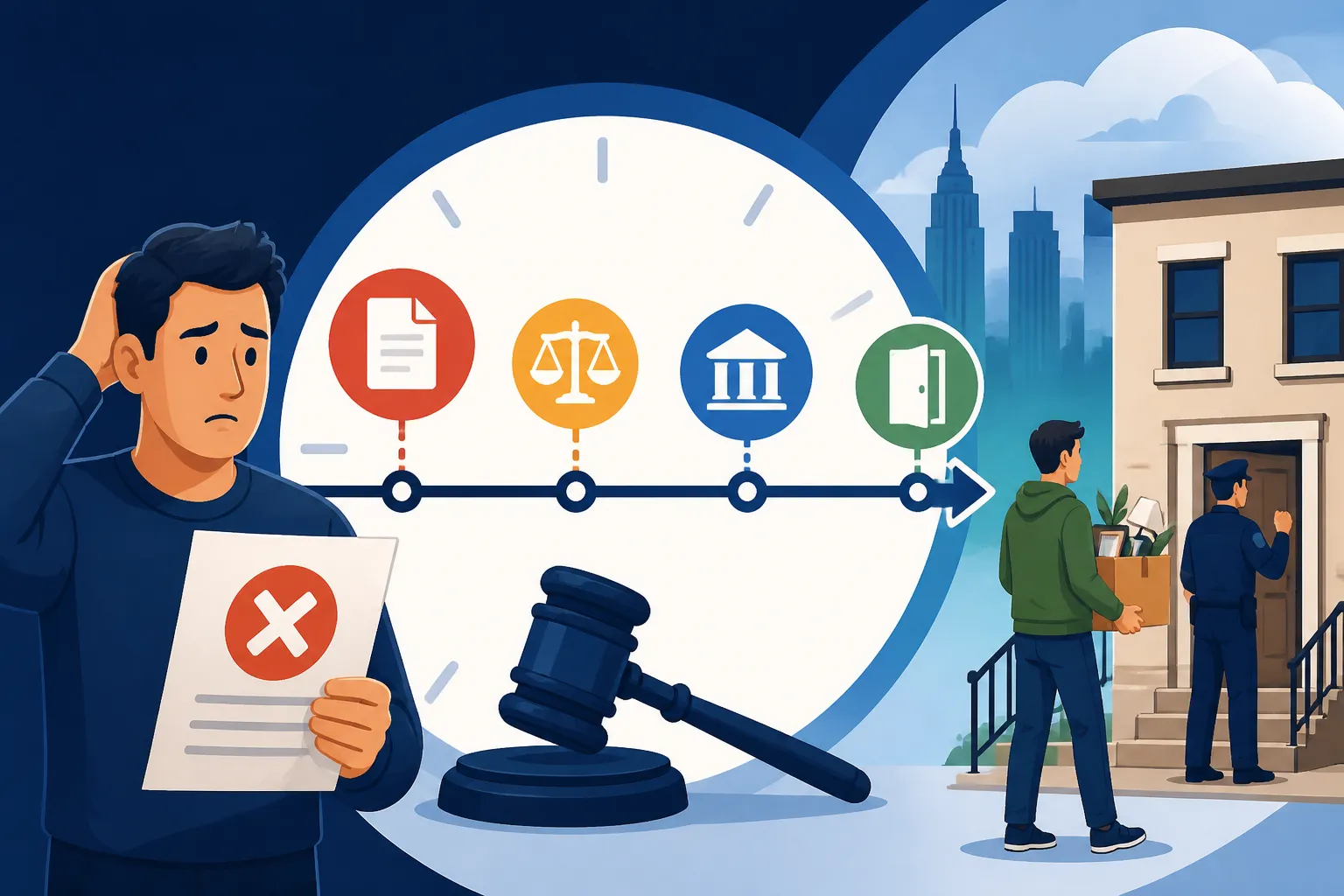
The entire process generally begins with a formal notice, moves into the court system with filings and hearings, and culminates, if successful, in a legal removal by a sheriff or marshal. There are no shortcuts, and "self-help" evictions like changing locks or shutting off utilities are highly illegal and can lead to severe penalties for landlords.
Initial Steps and Notice Requirements
Before a landlord can even think about filing an eviction lawsuit (called a "summary proceeding" in New York), they must provide the tenant with a formal written notice. The type of notice and the amount of time given depend heavily on the reason for the eviction and how long the tenant has resided in the property. This isn't just a friendly heads-up; it's a critical legal document. Many landlords find tools like those offered by LawDepot helpful for creating these legally sound notices to ensure they include all the necessary information and adhere to state requirements.
- Notice for Non-Payment of Rent: If a tenant hasn't paid rent, the landlord must issue a 14-day written "Notice to Pay Rent or Vacate." This notice gives the tenant two weeks to either pay the overdue rent in full or move out. If they don't do either, the landlord can then proceed to file a court case. It's important to note that rent is not considered "late" until five days after it's due, and landlords can only charge a late fee of $50 or 5% of the monthly rent, whichever is less, in New York.
- Notice for Lease Violations (Cure or Quit): For issues like unauthorized pets, excessive noise, or property damage not severe enough for an "unconditional quit" notice, landlords typically issue a "Notice to Cure." This notice usually gives the tenant 10 days to correct the violation. If the tenant fails to "cure" the breach within that time, the landlord can then issue a "Notice to Quit" and proceed with eviction.
- Notice for Holdover Tenants (No-Fault): This applies when a tenant's lease term has ended, and the landlord simply doesn't wish to renew it, or if there's a serious, incurable lease violation. The required notice period here is directly tied to how long the tenant has lived in the unit, thanks to the Housing Stability and Tenant Protection Act of 2019 (HSTPA):
- Less than one year of tenancy: 30 days' notice.
- One to two years of tenancy: 60 days' notice.
- More than two years of tenancy: 90 days' notice.
These extended notice periods are a significant change and offer tenants more time to find new housing, often adding substantial time to the overall eviction process. Ignoring these specific notice requirements is a common pitfall for landlords and can easily lead to a case being dismissed, forcing them to start all over again.
Filing an Eviction Lawsuit
Once the appropriate notice period has expired and the tenant has not complied, the landlord can officially begin the legal eviction process by filing papers with the court. In New York, these are typically filed in Housing Court, or in a local Justice Court (Town or Village Court) outside of New York City.
- Petition and Notice of Petition: The landlord (or their attorney) files a "Petition" with the court, outlining the reasons for eviction and requesting possession of the property. Along with this, a "Notice of Petition" is issued, which is a formal document notifying the tenant that an eviction case has been filed against them and stating the date, time, and location of their first court appearance. This is how the court officially tells the tenant they're being sued.
- Service of Process: This is a critical legal step. The Petition and Notice of Petition must be "served" on the tenant in a legally prescribed manner. This usually means personal delivery to the tenant. If personal service isn't possible after several attempts, the court might allow "substituted service" (e.g., leaving the papers with a person of suitable age and discretion at the property, then mailing copies) or "nail and mail" (affixing to the door and mailing). Improper service is another common reason eviction cases are delayed or dismissed, as it violates the tenant's due process rights.
- Court Scheduling: After proper filing and service, the court will schedule the first appearance. The time between filing and the first court date can vary greatly depending on the court's caseload, but typically it's between 10 to 17 days. In busy urban courts like those in New York City, it can sometimes be longer.
Navigating the Court System and Hearings
This is where things can really start to feel like they're crawling. The court phase of an eviction in New York is rarely a one-and-done deal. There are often multiple appearances, opportunities for settlement, and, if necessary, a full trial.
First Appearance and Adjournments
When the tenant and landlord (or their legal representatives) arrive for the first scheduled court date, they won't typically jump straight into a trial. This initial appearance is usually for administrative purposes and to explore settlement options.
- Initial Conference: The court will confirm that the tenant received proper notice and service. The judge or a court attorney may encourage the parties to try to settle the case. This often involves discussions about a payment plan, an agreement for the tenant to move out by a certain date, or addressing any repair issues that might be contributing to non-payment of rent. Legal aid services are often available to tenants in New York City and other areas, and having a lawyer can significantly impact a tenant's ability to negotiate or defend their case.
- Adjournments: It's incredibly common for cases to be "adjourned," or postponed, multiple times. This can happen for many reasons:
- Tenant seeks legal counsel: Tenants often need time to find and consult with an attorney.
- Mediation or settlement talks: Parties may request time to negotiate outside of court.
- Discovery: If either side needs to gather more information or documents, they might request time for "discovery."
- Court backlog: Courts, especially in large cities, can be extremely busy, leading to automatic adjournments.
- Hardship: Tenants can request a "hardship stay" if they can prove that immediate eviction would cause them undue hardship, especially if they have children, elderly family members, or disabilities.
Each adjournment adds weeks, sometimes even months, to the overall timeline. It's not uncommon for a case to see two, three, or even more adjournments before moving forward.
Trial and Judgment
If a settlement isn't reached through negotiation or mediation, the case will eventually proceed to a trial. This is where both sides present their evidence and arguments to the judge.
- Presenting Evidence: During a trial, the landlord must prove their case – for example, demonstrating that rent is owed and that all proper notices were served. The tenant, in turn, can raise defenses, such as improper service, uninhabitable conditions (like lack of heat or hot water, or a severe mold problem), or retaliatory eviction. Documentation is key for both sides. Landlords using property management software like DoorLoop can keep meticulous records of rent payments, communications, and repair requests, which can be invaluable evidence in court.
- Judgment: After hearing all the evidence, the judge will render a "judgment." If the landlord prevails, the judgment will award them possession of the property. It may also award a money judgment for unpaid rent and, in some cases, other damages. However, a judgment for possession does not mean the tenant is immediately removed. The process still has one more major hurdle: the Warrant of Eviction.
- Time from Trial to Judgment: The judge might issue a decision immediately, or they might "reserve decision," meaning they'll take time to review the evidence and issue a written decision later, which can add several days or even weeks.
| Eviction Stage | Typical Duration (New York) | Key Actions/Considerations |
|---|---|---|
| Notice Period | 14-90 days (depending on reason/tenancy length) | Landlord serves formal notice (e.g., 14-day Pay or Quit) |
| Court Filing & Service | 1-2 weeks | Landlord files Petition, tenant is served Notice of Petition |
| First Court Appearance | 2-4 weeks after filing | Initial conference, settlement talks, potential for adjournment |
| Adjournment(s) | 2-8 weeks (per adjournment) | Often multiple delays for legal aid, negotiation, or court backlog |
| Trial | 1 day to 1 week (if not settled) | Both sides present evidence; judge issues judgment |
| Judgment to Warrant | 1-2 weeks (after landlord wins) | Judge issues warrant; Marshal/Sheriff picks it up |
| Marshal's Notice | 14 days | Marshal/Sheriff serves final notice of physical eviction |
| Physical Eviction | Day 15 or later | Marshal/Sheriff physically removes tenant and belongings |
| Total Estimated Time | 2-6+ months, often longer in NYC | Can vary widely based on case complexity and tenant actions |
The Final Stages: Warrant of Eviction and Tenant Removal
Even after a landlord has secured a judgment for possession, the tenant isn't immediately forced out. There are still several legal steps that must be taken, providing additional time and opportunities for tenants to seek assistance or make arrangements. This is the stage where the enforcement of the court's decision happens.
Issuance and Service of the Warrant
The "Warrant of Eviction" is the legal document that authorizes a New York City Marshal (within NYC) or a County Sheriff (outside NYC) to physically remove the tenant from the property.
- Issuance of the Warrant: After the judge issues a judgment of possession, the landlord must obtain a Warrant of Eviction from the court clerk. The time it takes for the court to issue this warrant can vary, usually a few days to a week or two after the judgment. Once issued, the landlord typically gives the warrant to the appropriate Marshal or Sheriff.
- Marshal's / Sheriff's 14-Day Notice: This is a crucial protective measure for tenants. Once the Marshal or Sheriff receives the Warrant of Eviction, they must serve the tenant with a written "Notice of Eviction" (sometimes called a "Marshal's Notice" or "Execution Notice"). This notice explicitly informs the tenant that they have a minimum of 14 days to vacate the premises. The 14 days begin after this notice is properly served, not from the date of the court judgment.
- The Day of Eviction: Only after this 14-day period has fully expired can the Marshal or Sheriff return to the property to physically remove the tenant and their belongings. They must do so during regular business hours, typically Monday through Friday. Landlords are forbidden from doing this themselves; it must be done by authorized law enforcement. If the tenant is not present, the Marshal or Sheriff will oversee the removal of their belongings and secure the premises. This entire process, from judgment to physical removal, generally adds at least two to four weeks, sometimes more. For a deeper dive into the specifics, you can read our guide on The Writ of Possession & Sheriff Removal.
Potential Delays and Tenant Defenses
It's important to understand that an eviction timeline in New York is rarely linear. Many factors can cause significant delays, often stemming from the state's strong tenant protections.
- Stays of Eviction: Tenants have several avenues to seek a "stay" of eviction, which is a temporary halt to the process.
- Hardship Stays: As mentioned, tenants can ask the court for a stay based on hardship, especially if they have children, a disability, or are facing severe medical issues. These can last for several months, particularly if the tenant demonstrates they are actively trying to find new housing or resolve their situation.
- Emergency Rental Assistance Program (ERAP): If a tenant applies for New York's ERAP, it automatically triggers a stay of eviction proceedings for up to 12 months, provided the landlord is eligible and willing to participate. This program was designed to help tenants catch up on rent during economic difficulties and has significantly impacted eviction timelines.
- Order to Show Cause: Tenants can file an "Order to Show Cause" to ask the court to temporarily stop the eviction, often arguing that there's a new development or a legal error in the process.
- Illegal Self-Help Eviction: Any attempt by a landlord to bypass the legal process – such as changing locks, turning off utilities, removing doors, or otherwise trying to force a tenant out – is considered an illegal "self-help" eviction in New York. These actions can lead to severe penalties, including fines, damages to the tenant, and even criminal charges. If you're a tenant facing these issues, knowing your rights is crucial, and you might want to consult resources like our post on Illegal Self-Help Eviction Lockouts & Utility Shutoffs.
- Legal Aid and Tenant Advocacy: New York City, in particular, has a "Right to Counsel" law, meaning that tenants in Housing Court for eviction proceedings who meet certain income requirements are entitled to free legal representation. This has dramatically leveled the playing field and often extends the timeline as attorneys will thoroughly explore all possible defenses and appeals. Even outside NYC, various organizations offer legal assistance to tenants. For landlords, understanding How to Evict a Tenant legally and carefully is paramount to avoid these pitfalls.
In summary, a straightforward non-payment eviction in New York, assuming no complications or tenant defenses, might take 2-3 months from the initial notice to physical removal. However, with common delays like multiple adjournments, tenants securing legal aid, or applying for rental assistance programs, it is far more realistic to expect an eviction to take anywhere from 4 to 6 months, and complex or contested cases, especially in New York City, can easily stretch to a year or more. Navigating this landscape requires patience, strict adherence to the law, and often, legal counsel for both landlords and tenants.
Disclaimer
Please remember that this article is intended for informational purposes only and does not constitute legal advice. Landlord-tenant laws are complex and vary by jurisdiction, and this content may not be up-to-date with the latest legal changes. It is crucial to consult with a qualified attorney or legal professional for advice specific to your situation. Using this information does not create an attorney-client relationship.