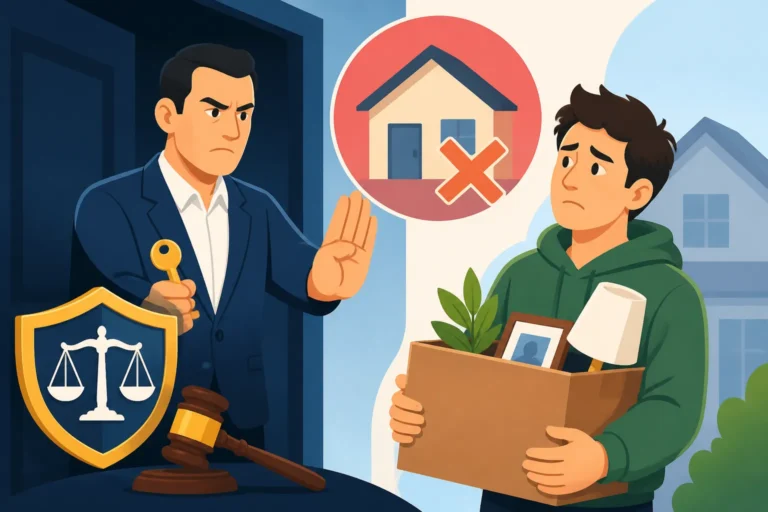
Self-Help Eviction Penalties by State
It's an absolutely terrifying scenario: you're a tenant, living your life, and suddenly your landlord takes matters into their own hands, changing the locks, shutting off utilities, or removing your belongings without a proper court order. This kind of sudden, illegal action can leave you feeling utterly powerless and stranded. This comprehensive guide is here to shed light on what a self-help eviction actually is, why it's strictly against the law, and the hefty penalties landlords face across different states for trying to bypass the legal eviction process.
Understanding Self-Help Evictions
Let's get one thing straight from the start: a landlord cannot legally evict you without going through the proper court process. It doesn't matter if you're behind on rent, if your lease has expired, or if you've done something to upset them. There's a formal, legal path to eviction that involves court filings, notices, and judge's orders. Anything less is a "self-help eviction," and it's almost universally illegal. It’s a landlord attempting to remove a tenant from a property without judicial oversight, using tactics that bypass the established legal system.
What Constitutes a Self-Help Eviction
Self-help evictions come in various forms, and they're all designed to make a tenant's living situation so unbearable that they're forced to leave. This isn't just unethical; it's illegal. The most common examples include:
- Changing the Locks: This is perhaps the most direct and recognizable form of self-help eviction. Your landlord simply rekeys your apartment or house, preventing you from entering. Imagine coming home from a long day at work, key in hand, only to find it doesn't fit the lock anymore. It's a shocking, invasive act that immediately cuts you off from your home and belongings. Even if they offer you a new key, the act of changing the lock without a court order is often illegal because it bypasses the legal due process.
- Shutting Off Utilities: Another common, and deeply cruel, tactic is cutting off essential services like electricity, water, gas, or heat. This isn't just an inconvenience; it can be a health and safety hazard, especially in extreme weather conditions. Picture a family with small children suddenly without heat in the dead of winter in Chicago, or no air conditioning during a sweltering summer in Phoenix. This creates an uninhabitable environment, forcing tenants out. Many states have specific protections against a landlord shutting off utilities to force a tenant out.
- Removing or Tampering with Belongings: Some landlords might take the liberty of removing your personal property from the rental unit, either placing it outside, in storage, or even discarding it. This is a clear violation of your right to peaceful possession and can lead to significant damages if your property is lost or damaged.
- Threats and Harassment: While not always physical, consistent verbal threats, intimidation, or aggressive behavior intended to scare you into leaving can also fall under self-help. This could include repeated, unannounced visits, yelling, or leaving menacing notes. It creates a hostile living environment, making the tenant feel unsafe and unwanted.
These actions are stark violations of tenant rights and are taken very seriously by courts. If you've experienced anything like this, it's critical to know your rights and act swiftly.
Why Self-Help Evictions are Illegal
The reason self-help evictions are illegal is fundamentally tied to the concept of "due process" and maintaining peace and order in society. Landlord-tenant law exists precisely to provide a structured, impartial method for resolving disputes, including evictions.
- Due Process Rights: Every tenant has a right to due process, meaning they have the right to be formally notified of any eviction proceedings, present their case in court, and have a judge make a ruling based on the law. A self-help eviction strips tenants of these fundamental rights. It's about ensuring fairness and preventing powerful landlords from arbitrarily removing tenants without a just cause proven in court.
- Preventing Chaos and Violence: Imagine a world where landlords could simply throw tenants out onto the street whenever they wished. It would lead to chaos, potential violence, and widespread homelessness. Legal eviction processes are designed to prevent such scenarios, ensuring that any removal is carried out by authorized personnel (like a sheriff) only after a court has deemed it lawful.
- Protection for Vulnerable Tenants: Many tenants are in vulnerable positions, often lacking the resources or legal knowledge to fight back against an unscrupulous landlord. Laws against self-help evictions provide a crucial safety net, ensuring that even the most vulnerable tenants have legal recourse and aren't subject to arbitrary displacement.
These protections are enshrined in state and federal law, making it clear that landlords must follow the proper legal channels, no matter how frustrated they might be with a tenant. Failing to do so can result in severe penalties, as we'll explore next. For a deeper understanding of the proper way to remove a tenant, you might want to read our guide on how to evict a tenant.
The Serious Ramifications for Landlords
When a landlord engages in a self-help eviction, they aren't just bending the rules; they're breaking the law, and the consequences can be incredibly severe. It's not just about a slap on the wrist; we're talking about substantial financial penalties, potential criminal charges, and a tarnished reputation that can follow them for years. Many landlords, perhaps out of ignorance or frustration, don't realize the magnitude of the risk they're taking when they bypass the legal eviction process.
Financial Penalties
The financial fallout from an illegal self-help eviction can be devastating for a landlord. Courts tend to be very sympathetic to tenants who have been illegally displaced, and they don't hesitate to impose significant monetary penalties to punish landlords and deter future illegal actions.
- Actual Damages: This is the most straightforward category. It covers any direct financial losses the tenant incurred due to the landlord's illegal actions. For example, if a tenant had to pay for a motel room because they were locked out, the landlord would be liable for those costs. If belongings were damaged or destroyed, the landlord would have to pay for their replacement or repair. This could also include lost wages if the tenant missed work dealing with the eviction, or the cost of alternative transportation if their car was blocked.
- Statutory Damages: Many states have specific laws that impose a fixed penalty for self-help evictions, regardless of the tenant's actual damages. These statutory damages are designed to punish the landlord and act as a deterrent. They can range from a few hundred dollars to several thousand dollars per violation or per day the tenant was dispossessed. For instance, in some areas, a landlord might be liable for two or three times the actual damages, or a set amount like one month's rent plus an additional penalty. This is often referred to as double vs treble damages for wrongful withholding, a concept that sometimes applies to illegal evictions as well.
- Punitive Damages: In cases where a landlord's actions are deemed particularly malicious, egregious, or reckless, a court might award punitive damages. These aren't meant to compensate the tenant for a loss but to punish the landlord and send a strong message that such behavior is unacceptable. Punitive damages can be substantial, often far exceeding the actual damages suffered by the tenant, and can really hit a landlord's pockets hard.
- Attorney Fees and Court Costs: If a tenant has to hire an attorney to fight an illegal self-help eviction, the landlord will almost certainly be ordered to pay the tenant's legal fees and court costs. This can quickly add up, turning what might have been a relatively minor dispute into a massive financial burden for the landlord. Even if the tenant used a service like LawDepot to prepare initial documents, the cost of going to court adds up quickly.
Consider a hypothetical in Los Angeles, California. A landlord illegally locks out a tenant. The tenant pays $200 a night for a hotel for five nights ($1,000), incurs $300 in moving expenses for their suddenly inaccessible belongings, and has $200 in damaged furniture. The total actual damages are $1,500. California law allows for $100 per day minimum statutory damages, so $500 for five days. Plus, the landlord could be on the hook for the tenant's attorney's fees, easily reaching several thousand dollars. Suddenly, a landlord's attempt to save time and money by avoiding the legal process results in a payout of many thousands of dollars, far more than the cost of a proper eviction.
Criminal Charges and Other Legal Troubles
Beyond the significant financial repercussions, landlords who engage in self-help evictions can also find themselves facing serious criminal charges and other long-lasting legal headaches. This isn't just a civil matter where money changes hands; it can escalate to criminal prosecution.
- Misdemeanor Charges: In many states and municipalities, an illegal lockout or utility shutoff is classified as a misdemeanor offense. This means the landlord could face arrest, criminal prosecution, fines, and even jail time. While jail time for a first offense is rare, the possibility exists, and a criminal record is a very real consequence that can impact their ability to conduct future business.
- Restraining Orders: A tenant who has been harassed or illegally evicted can seek a restraining order against the landlord, preventing them from coming near the tenant or the property. This can complicate property management, especially for small landlords who live near or manage their properties personally.
- Impact on Future Business: A history of illegal evictions or harassment can severely damage a landlord's reputation. It can make it difficult to secure loans for investment properties, obtain insurance, or even attract new tenants. Prospective tenants and lenders often conduct due diligence, and a record of illegal actions will be a major red flag. Property management software companies, like DoorLoop, might even have policies against working with landlords who have a history of such violations, further isolating them.
- Civil Rights Violations: In certain circumstances, if the self-help eviction is carried out with discriminatory intent (e.g., targeting a tenant based on race, religion, or familial status), it could lead to federal civil rights charges under the Fair Housing Act, carrying even more severe penalties and legal scrutiny.
The message is clear: the legal system takes tenant protections seriously. A landlord who decides to take the law into their own hands risks not just their finances but also their freedom and future business prospects. It's a lose-lose situation for anyone who tries to circumvent the legal process.
State-Specific Penalties for Self-Help Evictions
While the general principle that self-help evictions are illegal holds true across the United States, the specific penalties can vary dramatically from state to state. Some states have incredibly stringent laws designed to heavily penalize landlords, while others might have slightly less punitive, though still significant, consequences. It's crucial for both tenants and landlords to understand the specific nuances of their state's laws.
To give you a clearer picture, here's a breakdown of common penalties and how a few prominent states handle these illegal acts. Keep in mind that local ordinances in cities like New York City, Los Angeles, or Seattle can add even more layers of protection and penalties beyond state law.
| State | Typical Penalty Structure | Minimum Statutory Damages Often Include | Attorney's Fees Recoverable? | Potential Criminal Charges? |
|---|---|---|---|---|
| California | Actual damages + statutory damages (daily/fixed) + punitive | $100 per day (minimum $250) for lockout/utility shutoff | Yes | Misdemeanor |
| New York | Actual damages + statutory penalties (fixed per violation) | Up to $10,000 per violation, specific to illegal evictions | Yes | Misdemeanor |
| Texas | Actual damages + civil penalty (month's rent + $100) | One month's rent + $100 for lockout/utility shutoff | Yes | Misdemeanor |
| Florida | Actual damages OR 3 months' rent (whichever is greater) | 3 months' rent | Yes | Misdemeanor |
| Illinois | Actual damages + statutory damages (up to 2 months' rent) | Up to 2 months' rent, depending on locality (e.g., Chicago has its own specific penalties) | Yes | Misdemeanor |
This table provides a general overview and specific laws can vary. Always consult current state statutes or a legal professional for precise, up-to-date information.
California's Approach to Illegal Evictions
California is known for having some of the most robust tenant protections in the country, and its stance on self-help evictions is no exception. The Golden State takes a very dim view of landlords who try to take the law into their own hands.
Under California Civil Code § 789.3, if a landlord attempts to evict a tenant by cutting off utilities, changing locks, removing property, or using threats to force a tenant out, they face significant consequences. Tenants can recover:
- Actual Damages: Any financial losses directly incurred due to the illegal act (e.g., hotel costs, lost wages, property damage).
- Statutory Damages: A civil penalty of up to $100 for each day the landlord remains in violation, with a minimum penalty of $250. This means that if a landlord locks out a tenant for a week, they could owe at least $700 in daily penalties, plus the minimum.
- Punitive Damages: If the landlord's actions are particularly malicious, a court can also award punitive damages, which can be much higher than the actual losses, further punishing the landlord.
- Attorney's Fees and Court Costs: Crucially, the tenant is typically entitled to recover their reasonable attorney's fees and court costs. This provision is designed to ensure tenants can afford to enforce their rights, even against well-resourced landlords.
Imagine a tenant in San Francisco who is illegally locked out for 10 days. They spend $2,000 on temporary housing and lose $500 in wages. Their actual damages are $2,500. Under California law, the landlord would also owe at least $1,000 in statutory damages ($100 x 10 days). Add in attorney's fees, which could easily be $5,000-$10,000, and the landlord is suddenly facing a bill upwards of $8,500 to $13,500, all for trying to avoid a legal eviction process that might have cost a fraction of that. This clearly demonstrates why it's so important for landlords to follow the Security Deposit Laws by State (2026), and all other tenant-landlord laws.
New York's Tenant Protections
New York, particularly New York City, has some of the strongest tenant protection laws in the nation, reflecting its high renter population and competitive housing market. These laws are designed to prevent landlords from harassing or illegally displacing tenants.
In New York, illegal evictions, harassment, and other self-help measures are taken very seriously. Under various sections of the Real Property Law and specific city codes (like the NYC Housing Maintenance Code), landlords can face:
- Actual Damages: Similar to California, tenants can recover all financial losses.
- Statutory Penalties: In New York City, for instance, a landlord found guilty of an unlawful eviction can face civil penalties ranging from $1,000 to $10,000 for each violation. The law is designed to be highly punitive to deter such actions.
- Punitive Damages: Again, if the actions are found to be malicious, punitive damages are a real possibility.
- Attorney's Fees: Tenants are generally entitled to recover their legal fees.
A landlord in Brooklyn, New York, who removes a tenant's belongings and changes the locks without a court order might not only face the tenant's actual damages for lost property and temporary housing but also thousands of dollars in statutory fines per violation. If the court finds the actions particularly egregious, they could be on the hook for a five-figure sum, plus the tenant's attorney fees, which in New York City can be substantial. This clearly illustrates why understanding the nuances of how to stop or fight an eviction is so important for tenants in New York.
Texas's Stance on Self-Help
Texas generally favors landlords in some aspects of landlord-tenant law, but it has very clear and strict prohibitions against self-help evictions. The state's Property Code outlines significant penalties for landlords who violate these rules.
Under Texas Property Code § 92.008, a landlord who attempts to remove a tenant by cutting off utilities or locking them out (unless it's for a legitimate repair with proper notice, or abandonment) is subject to:
- Reinstatement of Possession: The tenant has the right to immediately regain entry to the property.
- Actual Damages: Compensation for any financial losses.
- Civil Penalty: A civil penalty equal to one month's rent plus $100. This is a significant fixed penalty designed to deter illegal actions.
- Attorney's Fees: The tenant can recover their reasonable attorney's fees and court costs.
For example, if a landlord in Houston illegally locks out a tenant paying $1,500 a month in rent, the tenant could get their locks changed back, receive their actual damages, plus a civil penalty of $1,500 + $100 = $1,600, on top of any legal fees. This penalty quickly adds up, making self-help evictions a very expensive mistake in Texas.
Florida's Strict Laws
Florida is another state with strong statutes protecting tenants from illegal landlord actions, particularly regarding self-help evictions. The penalties are designed to be a significant deterrent.
Under Florida Statutes § 83.67, a landlord is prohibited from directly or indirectly interrupting utility services, removing outside doors/locks, removing personal property, or using threats to gain possession of the unit from a tenant. If a landlord violates these provisions, the tenant can:
- Recover Possession: The tenant can get back into their rental unit.
- Actual Damages: All damages incurred due to the illegal act.
- Statutory Damages: The landlord is liable for an amount equal to three months' rent, OR actual damages, whichever is greater. This is a very substantial penalty designed to hit landlords hard financially.
- Attorney's Fees: The tenant is entitled to their reasonable attorney's fees and court costs.
Consider a tenant in Miami whose landlord illegally shuts off their electricity and water for five days. The tenant pays $2,000 a month in rent. The actual damages might include a few hundred dollars for takeout and temporary fan purchases. However, the landlord would be liable for at least $6,000 (three months' rent), plus the tenant's attorney's fees. This makes Florida's penalties some of the most severe, ensuring that landlords think twice before attempting a self-help eviction.
Illinois's Penalties
Illinois law also provides robust protections against self-help evictions, particularly in major urban centers like Chicago, which has its own specific Residential Landlord and Tenant Ordinance (RLTO) that adds further layers of tenant rights.
Under Illinois law (765 ILCS 735/2), if a landlord illegally attempts to evict a tenant by force or by denying them access to the property, the tenant can:
- Recover Possession: The tenant can regain access.
- Actual Damages: Compensation for financial losses suffered.
- Statutory Damages: The tenant may recover an amount equal to up to two months' rent or actual damages, whichever is greater, in certain situations.
- Attorney's Fees: The landlord will likely be responsible for the tenant's legal fees and costs.
In Chicago, the RLTO adds even more stringent protections. If a landlord locks out a tenant without a court order, they could be liable for two months' rent or actual damages, whichever is greater, plus attorney's fees. Furthermore, the RLTO imposes fines for violating various provisions, including those against illegal evictions. So, a landlord in Chicago who attempts a self-help eviction of a tenant paying $1,800 a month could easily face a penalty of $3,600 (two months' rent) on top of actual damages and significant attorney's fees. The importance of proper documentation at move-in and throughout the tenancy becomes critical when considering such high stakes.
The message is consistent across these states: the legal eviction process is the only legal path. Any attempt to circumvent it will lead to substantial penalties, often far exceeding the time and expense of a legitimate eviction.
Tenant Rights and How to Respond
If you find yourself in the terrifying situation of a landlord attempting a self-help eviction, it's natural to feel scared, angry, and confused. But remember, you have rights, and there are concrete steps you can take to protect yourself and hold your landlord accountable. You are not alone, and the law is on your side.
Immediate Actions to Take
The moment you suspect your landlord is engaging in self-help eviction tactics, your immediate priority should be to document everything and ensure your safety.
- Do Not Engage in Confrontation: While your emotions might be high, try to remain calm and avoid direct confrontation that could escalate the situation. Your goal is to gather evidence and seek legal recourse, not to create a volatile situation.
- Document Everything Thoroughly: This is absolutely critical.
- Photos and Videos: Take pictures or videos of anything that shows the illegal act. Is the lock changed? Take a picture of the new lock. Are your belongings outside? Film them. Is the power meter tampered with? Get that on camera. Note the date and time.
- Witnesses: If possible, get contact information from any neighbors or friends who witnessed the landlord's actions. Their testimony can be invaluable.
- Communication Records: Save all texts, emails, or written notices from your landlord, especially those that might hint at their intentions or confirm their actions. If they left a note on your door, photograph it.
- Contact the Police (Non-Emergency Line): If you are locked out or your safety is at risk, call the non-emergency police line. Explain that your landlord is illegally evicting you without a court order. While police generally don't get involved in civil landlord-tenant disputes, an illegal lockout or utility shutoff can sometimes be a criminal offense or at least merits a police report documenting the incident. They might not force your landlord to let you back in immediately, but a police report creates an official record of the event.
- Contact Your Local Housing Authority or Tenant Rights Organization: Many cities and counties have housing departments or non-profit organizations dedicated to tenant advocacy. They can provide immediate advice, inform you of your rights, and connect you with legal resources. Organizations like Legal Aid Societies are often a great first step.
- Secure Temporary Housing (if necessary) and Keep Receipts: If you are locked out and have no other choice, find a safe place to stay, whether it's a hotel or a friend's couch. Keep detailed receipts for any expenses incurred, as these will form part of your actual damages in a potential lawsuit.
Remember, the goal is to create a clear, undeniable record of what happened. This evidence will be your strongest asset if you need to pursue legal action.
Seeking Legal Counsel
Once you've taken immediate steps to secure your safety and document the situation, the next crucial step is to seek legal counsel. Landlord-tenant law can be complex, and a qualified attorney can guide you through the process, ensuring your rights are protected.
- Why an Attorney is Essential: An attorney specializing in tenant rights will know the specific laws in your state and locality regarding self-help evictions. They can:
- Advise you on the strength of your case and the potential damages you could claim.
- Help you draft demand letters or file the necessary court documents.
- Represent you in court, which is especially important if your landlord has legal representation.
- Help you navigate the complexities of suing a landlord for your deposit.
- Finding an Attorney:
- Legal Aid Services: If you have a low income, many Legal Aid organizations offer free or low-cost legal assistance.
- Bar Associations: Your state or local bar association can provide referrals to landlord-tenant attorneys.
- Tenant Rights Groups: As mentioned earlier, these groups often have lists of recommended attorneys or in-house legal support.
- Preparing for Your Consultation: Bring all your documentation: lease agreement, photos, videos, communications with your landlord, police reports, and receipts for expenses. The more organized you are, the more effectively your attorney can assess your situation.
Seeking legal advice early can prevent further damage and significantly increase your chances of a successful outcome. Don't wait, especially if you're dealing with issues like a landlord won't return your deposit after 30 days.
Pursuing a Lawsuit for Damages
With legal counsel, you can decide whether to pursue a lawsuit against your landlord for the illegal self-help eviction. This often involves going to small claims court or civil court, depending on the amount of damages you are seeking.
- Small Claims Court: This is an option for many tenants, especially if the total damages are within the court's monetary limits (which vary by state, often ranging from $5,000 to $10,000 or more). Small claims court is designed to be accessible to individuals, and you might not even need an attorney, although having one is always beneficial. Here, you would present your evidence, explain what happened, and ask the judge for the damages you are owed.
- Civil Court: If your damages exceed the small claims limit, or if you are seeking significant punitive or statutory damages, you would file a lawsuit in a higher civil court. This is a more formal process and almost always requires an attorney.
- What You Can Claim: In a lawsuit for self-help eviction, you can typically claim:
- Actual Damages: Reimbursement for all direct financial losses (e.g., hotel bills, damaged property, lost wages, moving costs).
- Statutory Damages: The specific penalties outlined in your state's laws (e.g., $100 per day in California, three months' rent in Florida).
- Punitive Damages: If your landlord's actions were particularly malicious, a court might award these.
- Attorney's Fees and Court Costs: In most states, the landlord will be ordered to pay your legal expenses.
The purpose of such a lawsuit is not only to recover your losses but also to hold the landlord accountable and deter them from harming other tenants in the future. It’s a powerful tool for justice and for asserting your rights. Remember, knowledge is power, and understanding concepts like the itemized security deposit deduction statement explained can help you protect your finances even before an eviction issue arises.
Preventing Self-Help Evictions for Landlords
While this guide focuses on penalties and tenant rights, it’s worth noting that landlords can completely avoid these severe ramifications by simply adhering to the law. Understanding and following proper legal procedures is not only the ethical path but also the most financially prudent one. Being a good landlord means respecting tenant rights, even when disputes arise.
Following Proper Legal Eviction Procedures
The most effective way for a landlord to prevent self-help eviction penalties is to never engage in self-help to begin with. The legal system provides a clear, step-by-step process for lawful evictions that, while sometimes lengthy, protects both landlord and tenant.
- Provide Proper Notice: The first step in any legal eviction is to serve the tenant with a formal, written eviction notice. The type of notice and the required timeframe depend on the reason for eviction and state law. For example, a "3-Day Notice to Pay or Quit Explained" is common for non-payment of rent, while a longer notice might be required for lease violations.
- File an Eviction Lawsuit (Unlawful Detainer Action): If the tenant does not comply with the notice, the landlord must then file an eviction lawsuit (often called an "unlawful detainer" action) in court. This formally initiates the legal process.
- Serve the Tenant with Court Papers: The tenant must be properly served with the summons and complaint, giving them official notice of the lawsuit and an opportunity to respond.
- Attend the Court Hearing: Both landlord and tenant present their cases to a judge or jury. The judge then makes a ruling based on the evidence and the law.
- Obtain a Writ of Possession: If the judge rules in favor of the landlord, they will issue a "Writ of Possession." This is a court order that authorizes law enforcement (typically the sheriff) to remove the tenant and their belongings from the property.
- Sheriff Executes the Eviction: Only the sheriff or an authorized official can physically remove a tenant and their property. A landlord cannot do this themselves.
Following this structured process, as outlined in guides like the Eviction Process by State (Step-by-Step), ensures that the eviction is legal and minimizes the risk of facing penalties for self-help actions. It's a fundamental aspect of how to file for eviction properly.
Understanding Lease Agreements and Local Laws
A proactive approach to avoiding self-help eviction penalties also involves a deep understanding of lease agreements and relevant landlord-tenant laws. Ignorance of the law is never an excuse in court.
- Comprehensive Lease Agreements: A well-drafted lease agreement, perhaps created using legal templates from resources like LawDepot, clearly outlines the terms of the tenancy, tenant and landlord responsibilities, and the consequences of lease violations. This helps set clear expectations and provides a basis for legal action if a tenant breaches the agreement.
- Staying Current on Landlord-Tenant Laws: Laws change, and they vary significantly by state and even by city. Landlords must stay informed about the specific landlord-tenant laws in their jurisdiction, including rules regarding security deposits, repair responsibilities, and, crucially, eviction procedures. Resources from state housing authorities or even professional property management associations can be invaluable.
- Professional Property Management: For landlords who find managing properties complex or time-consuming, hiring a professional property management company or using dedicated software like DoorLoop can be a wise investment. These services often ensure compliance with all legal requirements, reducing the risk of accidental or intentional self-help actions and the severe penalties that come with them.
Ultimately, preventing self-help eviction penalties boils down to respecting the law and the rights of tenants. The legal process is there for a reason, and following it diligently is the only way to ensure a lawful and penalty-free eviction.
Disclaimer
Please remember that this article provides general information and is not a substitute for professional legal advice. Landlord-tenant laws are complex and vary significantly by state and local jurisdiction. If you are a tenant facing an illegal eviction or a landlord considering an eviction, it is crucial to consult with a qualified attorney or legal aid service in your area to understand your specific rights and obligations.